Case History:
B. Lynch syndrome (LS)
C. Li-Fraumeni syndrome (LFS)
D. Hereditary leiomyomatosis and renal cell carcinoma syndrome (HLRCC)
E. Peutz-Jeghers syndrome (PJS)
Correct Answer: A. von Hippel-Lindau (VHL) syndrome
Discussion:
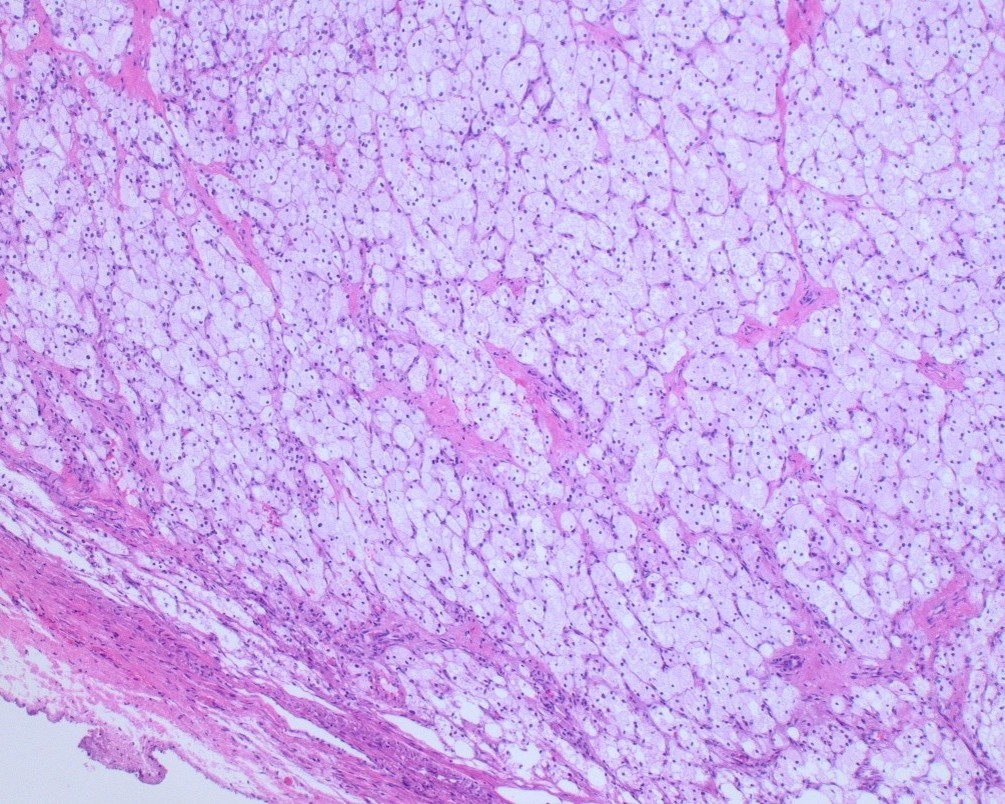
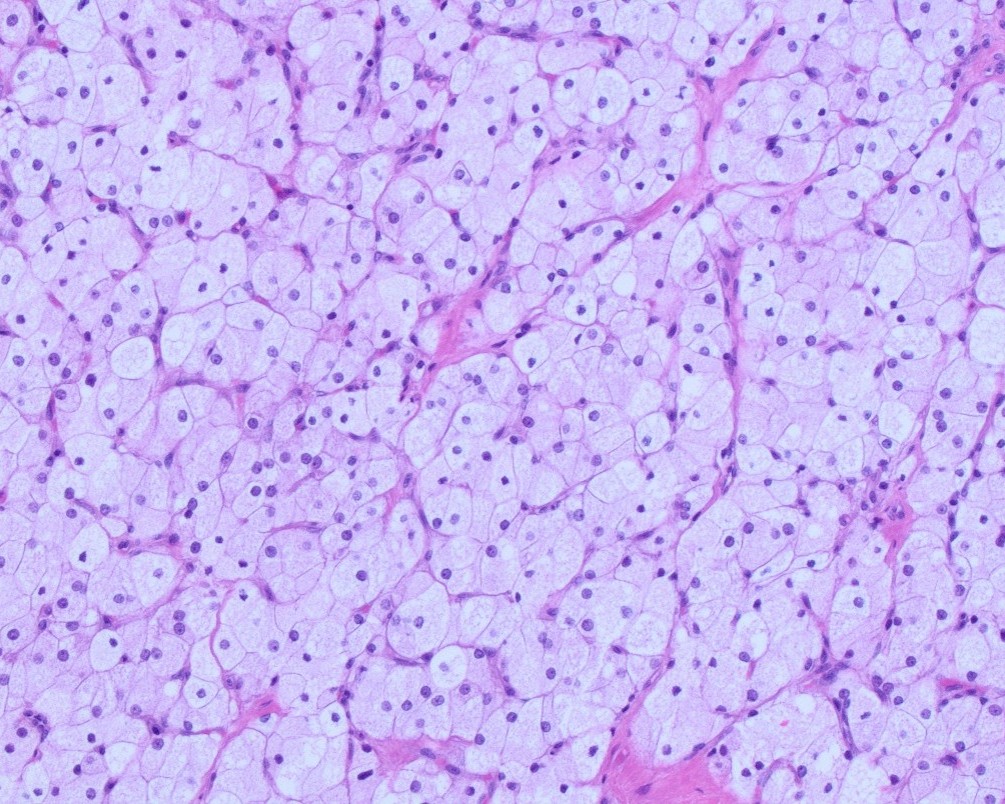
The left ovarian mass corresponds to a steroid cell tumor (SCT), not otherwise specified (NOS), which accounts for less than 0.1% of all ovarian neoplasms. SCTs correspond to non-hilar steroid tumors and are presumed to be of ovarian cell origin. They lack the typical morphologic features of Leydig cells and show distinct cell membranes with abundant eosinophilic granular or vacuolated (lipid rich) cytoplasm. The nucleus is round and central with no to mild atypia, showing a prominent central nucleolus. The distinction between Leydig cell tumors and steroid cell tumors NOS is crucial since approximately one-third of the latter exhibit a malignant clinical behavior, with a potential for extraovarian spread. Tumor diameter ≥ 7 cm, diffuse moderate to severe atypia, high mitotic activity ≥ 2/10 HPFs, necrosis, and hemorrhage are features associated with a malignant behavior.
Little is known regarding the molecular biology of these tumors. Associations with von Hippel–Lindau syndrome have been reported, suggesting that this neoplasm could enter the spectrum of this syndrome, although somatic molecular studies have not yet been performed. Recent molecular sequencing of steroid cell tumors (NOS) has revealed occasional pathogenic variants in hypoxia-pathway and metabolic genes like VHL. Lynch syndrome (LS) is an established, guideline-recognized cause of epithelial ovarian cancer. Risk depends on the gene. LS is associated with ovarian serous or clear cell carcinomas and there are not described associations with sex cord stromal tumors. Ovarian tumors occur in Li-Fraumeni syndrome (LFS) but are not core LFS tumors, and whether the risk is truly raised is still debated. Epithelial carcinomas, mostly high-grade serous, make up most reported cases. They tend to arise at a younger age than sporadic ovarian cancer.
Ovarian tumors are not an established part of hereditary leiomyomatosis and renal cell cancer (HLRCC) syndrome. The main gynecologic problem in HLRCC is early-onset, multiple uterine leiomyomas.
Peutz-Jeghers Syndrome (PJS) is classically associated with sex cord tumors with annular tubules (SCTAT) and Sertoli cell tumors.
References:
Trecourt A, Donzel M, Alsadoun N, Allias F, Devouassoux-Shisheboran M. Relevance of Molecular Pathology for the Diagnosis of Sex Cord-Stromal Tumors of the Ovary: A Narrative Review. Cancers (Basel). 2023 Dec 15;15(24):5864. doi: 10.3390/cancers15245864. PMID: 38136408; PMCID: PMC10741682.
de Lucio Delgado A, Rubio JAV, Mora EH, Fernández-Velasco AA. von Hippel-Lindau syndrome and steroid cell tumor of the ovary: A case report. Pediatr Blood Cancer. 2023 Oct;70(10):e30543. doi: 10.1002/pbc.30543. Epub 2023 Jul 8. PMID: 37421226.
Marques A, Portugal R. Ovarian Steroid Cell Tumor in an Adolescent With Von Hippel-Lindau Syndrome: A Case Report and Review of the Literature. Int J Gynecol Pathol. 2020 Sep;39(5):473-477. doi: 10.1097/PGP.0000000000000628. PMID: 31433374.
Case contributed by: Valeria Dal Zotto, M.D., Associate Professor, Women's Health