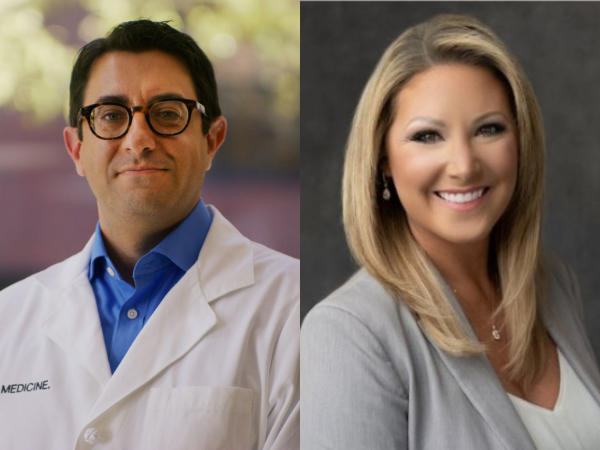
 Matthew Macaluso, D.O. and Kimberly Smith, Ph.D.When patients in rural or underserved communities need mental health care, access to a psychiatrist can be difficult. Project ECHO Depression at UAB was created to help bridge that gap by equipping primary care providers with the knowledge and support they need to manage common mental health conditions close to home.
Launched in 2021, Project ECHO Depression uses the nationally recognized Extension for Community Healthcare Outcomes (ECHO) model, originally developed at the University of New Mexico, to connect specialists with community providers through ongoing virtual education and case-based learning. Matthew Macaluso, D.O., professor and vice chair for clinical affairs in the Department of Psychiatry and Behavioral Neurobiology, was inspired after participating in an ECHO Autism session at the University of Kansas before he came to UAB.
"The idea is to move knowledge, not patients," Macaluso said. "The ECHO model can help to extend the expertise that we have out into the communities of any state, particularly communities that lack specialists or subspecialists, to help improve patient care."
Macaluso brought the concept to UAB shortly after arriving in 2020. Working alongside Kimberly Smith, Ph.D., assistant professor in the Department of Health Services Administration and Director of Evaluation for the Center of Clinical and Translational Science, they developed an ECHO program at UAB focused on depression and mental health care. According to Macaluso, ECHO Depression remains one of the only ECHO programs in the country dedicated specifically to depression and psychiatric illness while incorporating integrative behavioral health.
“The primary target of the program is to assist rural primary care physicians and their patients with managing difficult-to-treat depression and other mental illness,” Macaluso explained. “And I start with that because it's always focused on the patient.”
The program emerged at a critical time, Smith added. In the aftermath of the COVID-19 pandemic, mental health concerns increased significantly, while wait times for specialty psychiatric care continued to grow. Meanwhile, many patients turned to primary care physicians they already knew and trusted for help.
"We saw a spike in mental health-related concerns presenting at primary care," Smith said. "The question became, how do we support them? We couldn't have every patient referred to psychiatry when waits were months long, so using this ECHO model really seemed to be a great way to start moving knowledge, not patients, so that we could help them help their patients."
The program connects a multidisciplinary "hub" team of UAB experts with a statewide network of "spoke" sites, including physicians, nurses, nurse practitioners, physician assistants, psychologists, social workers, and other health professionals, primarily at primary care sites throughout the state.
Held virtually, each one-hour session includes a de-identified patient case discussion, expert guidance from the hub team, and a brief educational presentation. Participants also receive access to resource materials and continuing medical education credit.
"It is a collaborative and nonjudgmental group," Macaluso said. "There are no poor or wrong questions. All of us as clinicians struggle with very difficult patients and very difficult decisions."
For Smith, some of the program's greatest successes have come from the relationships formed among participants.
"We've had providers be able to reach out to our hub team outside of just our sessions and help in a crisis situation or with a really difficult, complex case," she said. "If we can get our providers to feel confident and have the mentorship and collaboration of someone like a psychiatrist to help figure out the best treatment plan, that's a win."
Looking ahead, program leaders plan to continue to expand session topics beyond depression to include conditions such as anxiety, substance use disorders, post-traumatic stress disorder, and ADHD, reflecting the growing mental health needs seen in primary care settings.
"We want to help in any and every way possible," Macaluso said. "If we share that expertise with primary care doctors throughout the state and the region, they'll have the confidence to do some of this work in their clinics, and it will save spots in our clinics for the most ill and most treatment-refractory patients."
Learn more about Project ECHO Depression and register for upcoming sessions.