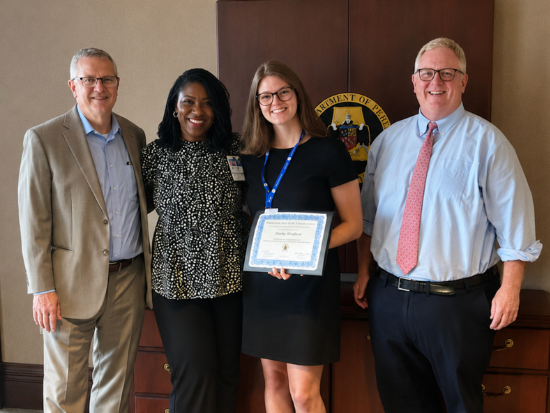
 Scott Harris, M.D., Amber Clark-Brown, M.D., Darby Watford, MS2, and Louis Lambiase, M.D. (left to right)Since 2023, medical students at the UAB Montgomery Regional Medical Campus have had a unique opportunity to see how medicine, public health, and policy intersect through the ADPH Summer Research Program. We spoke with Public Health Officer, Amber Clark-Brown, M.D., who has helped lead the initiative since joining the Alabama Department of Public Health (ADPH), to discuss the program's origins, goals, and impact as it celebrates its fourth year.
The idea began when Louis Lambiase, M.D., regional dean of the Montgomery Regional Medical Campus, approached Scott Harris, M.D., state health officer for the Alabama Department of Public Health (ADPH), about creating a program that would showcase the impactful work taking place in Montgomery.
As the state capital and home to both the Montgomery Regional Medical Campus and the Alabama Department of Public Health, Montgomery provides a unique setting where students can gain exposure to the many ways healthcare, public policy, and government work together to improve the health of communities.
"The main goal is to introduce medical students to public health," Clark-Brown said. "What makes our research program unique is that it incorporates a policy component."
"Each year, students connect their research projects to policy, whether that involves state policy, national policy, regulations, laws, or local initiatives," Clark-Brown said.
The aim, she explained, is to help students understand that policy influences everything, from how they will practice medicine to how governmental public health functions. That policy focus extends far beyond the classroom.
Throughout their time in the program, students join environmental health specialists during inspections of restaurants, tattoo parlors, and other facilities, gaining insight into the regulatory side of healthcare. Students have the opportunity to meet with legislators to better understand the connection between medicine, policy, and public service. And over the past two years, students have expanded their experience through visits to Project Horseshoe Farm in Greensboro, Alabama, where they learn about community-based health initiatives and the role of health advocates in addressing local needs.
"There is a strong focus on developing the technical skills needed to practice medicine, but leadership skills are equally important," Clark-Brown said, drawing on her own experience as a physician executive.
"I have learned many lessons throughout my career, including things I wish I had known earlier," Clark-Brown said. "I want to share those experiences with the trainees I work with and help them develop as future leaders."
Clark-Brown was candid about why early public health exposure matters, even for students headed toward more traditional clinical careers.
"We have called ourselves the 'silent guardians' because we work behind the scenes to help people live healthier lives," Clark-Brown said. "Future physicians may not work in public health, but they need to understand the services public health provides for them and their patients."
She also hopes the program broadens students' sense of what a medical career can look like. Clark-Brown, who has worked in public health for years and is now pursuing a master's in public administration, sees herself as living proof of that broader path.
"There is nothing wrong with being a clinician—we need physicians at the bedside," Clark-Brown said. "However, as healthcare continues to change, we also need physicians and physician executives who can combine clinical experience with leadership and administrative skills to help move healthcare forward."
The program, which runs from June to July, culminates in a milestone experience where students present their final research projects to ADPH State Health Officer Scott Harris, M.D., along with other senior leaders and key stakeholders.
"This serves several purposes," Clark-Brown said. "It not only highlights the hard work students have put into their projects, but it also gives them valuable oral presentation experience to include on their CVs."
Just four years in, the ADPH Summer Research Program has become more than a summer rotation. It's a pipeline for the kind of physician leaders Alabama's public health system will need in the years ahead. And for Clark-Brown, that growth is a team effort worth celebrating.
"We are very appreciative of this program," Clark-Brown said, crediting Louis Lambiase, M.D., Scott Harris, M.D., and epidemiologist Ana Oliveira, M.D., for their continued commitment.
"The students have had great experiences, and we receive positive feedback every year," Clark-Brown said. "We look forward to continuing to expand the program."
Through research, policy, leadership, and mentorship, Clark-Brown and her colleagues are giving students a wider lens on what it means to practice medicine and a head start on the leadership skills they'll need wherever their careers take them.