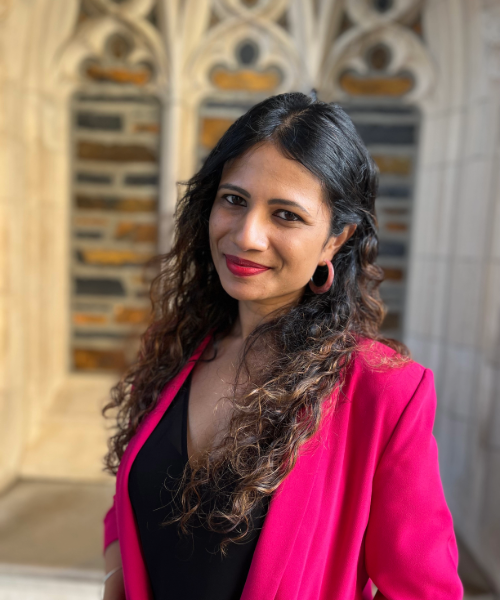
 Juhi Samal, Ph.D., assistant professor in the Department of Biomedical Engineering, personifies UAB’s commitment to pioneering research. Her work illustrates how bold science, dedicated mentorship, and meaningful collaboration unite in one shared mission to help the brain heal.
This year, Samal became the first UAB faculty member to receive the Biomedical Engineering Society's Cellular and Molecular Bioengineering (CMBE) Rising Star Award, a national recognition that she says reflects both her own path and the people who helped build her lab.
“On a personal level, it's meaningful because it recognizes my scientific journey (across three different continents) of building an independent research program around an emerging area at the intersection of glycobiology, neuroinflammation, and regenerative medicine,” said Samal.
The award also brought national attention to a growing area of strength at UAB. Long recognized for cardiovascular research, the Department of Biomedical Engineering is now making its mark in neuroengineering and glycoscience. For her part, Samal is quick to share the credit.
“Science is a team effort, and every student, trainee, and collaborator has contributed to the work that made this possible,” said Samal. “If this award inspires our students to think boldly about their own potential, then that's probably the part I'm most proud of.”
That focus on trainees was evident again this year, when two undergraduate researchers in the Samal Lab, Robert Munive and Maribel Marrero, earned Presidential Honors Fellowships. Since the lab's first year, its undergraduate researchers have consistently earned the fellowship.
“To me, that reflects a culture of both scientific excellence and training excellence,” said Samal. “We set high expectations, but we also invest heavily in mentoring students, so they have the tools, confidence, and support to succeed.”
At the heart of her students’ success is Samal’s personal investment in each of them. That investment earned her the 2026 Provost’s Award in Faculty Excellence in Undergraduate Research, which honors faculty members who show extraordinary commitment to engaging undergraduates in research.
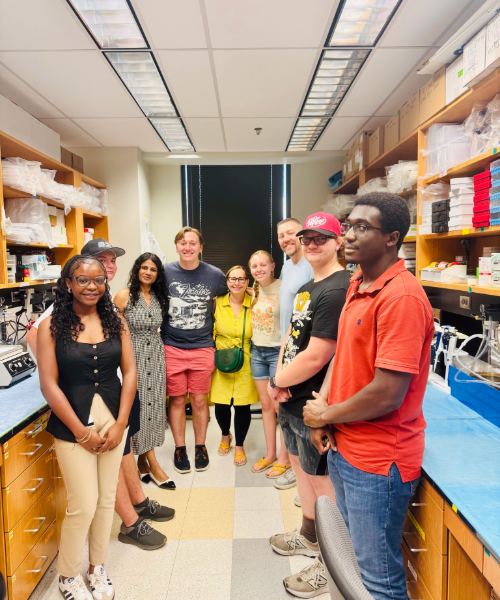 Behind that mentorship is research with real stakes for patients. The Samal Lab studies glycans, sugar molecules that coat the surface of cells, to better understand how they influence inflammation and healing in the brain.
“These sugar molecules act like a communication system for cells, but we still don't fully understand their role in neurological diseases,” said Samal. “Our goal is to decode that language and use it to develop new therapies that help the brain repair itself after injury or disease.”
That scientific approach is drawing support from beyond UAB. This year, the Samal Lab received an American Heart Association Rapid Impact Grant in recognition of its innovative contributions to stroke research.
Closer to home, Samal’s work is part of a broader push at UAB. She joined the university as the department’s strategic hire in neuroengineering, part of School of Engineering Dean Jeffrey Holmes’ vision to establish the field as a research priority. Since then, she has watched a strong community take shape around stroke, epilepsy, Parkinson’s disease, and neuromodulation.
“What's particularly impressive is that each of these hires has built a highly impactful research program while developing collaborations across multiple schools and disciplines at UAB,” said Samal. “That collaborative culture has created tremendous momentum and positioned UAB as an exciting place for innovation in brain health and neuroengineering.”
Building on that momentum, Samal is leading her lab into uncharted territory. With support from an inaugural Heersink School of Medicine Team Science Project award, the lab is now expanding into addiction research, connecting glycoscience with entirely new questions in neuroscience.
“That kind of collaboration is where I think the next big breakthroughs will happen,” said Samal. “We're still early on in our journey, which means there are exciting opportunities for students, collaborators, and partners to help shape where we go next.”
Looking ahead, Samal envisions the lab becoming a leading hub for glycoscience-driven regenerative medicine, one that uncovers how glycans affect inflammation, repair, and recovery in the nervous system. For her, that future depends as much on people as on discoveries.
“We're building something bigger than a research program,” said Samal. “We're building a community that advances healthcare research, creates opportunities, and trains the next generation of innovators who will make a lasting impact on human health.”
A historic national honor, standout trainee achievements, and new cross-disciplinary research affirm Samal’s growing influence in neuroengineering and glycoscience. Her work continues to advance the understanding of how the brain heals while preparing the next generation of engineers and scientists to do the same.