
We make assumptions every day, often based on limited information. The Ladder of Inference provides a simple framework for recognizing those assumptions and making more informed decisions.
Imagine you're in a meeting and suggest a new idea.
A few people nod. One colleague stares at their laptop and says nothing.
By the end of the meeting, you've decided they're not supportive of your idea.
The interesting part? None of that was actually said.
What you observed was a colleague looking at their laptop and staying quiet. Everything else was an interpretation,. Most of us do this every day without realizing it. This is where the Ladder of Inference comes in.
Developed by Chris Argyris and Donald Schön, the Ladder of Inference is a model that explains how people move from observing information to drawing conclusions and taking action. It reminds us that we're not always reacting to facts — we're often reacting to the meaning we've attached to those facts.
How the Ladder Works
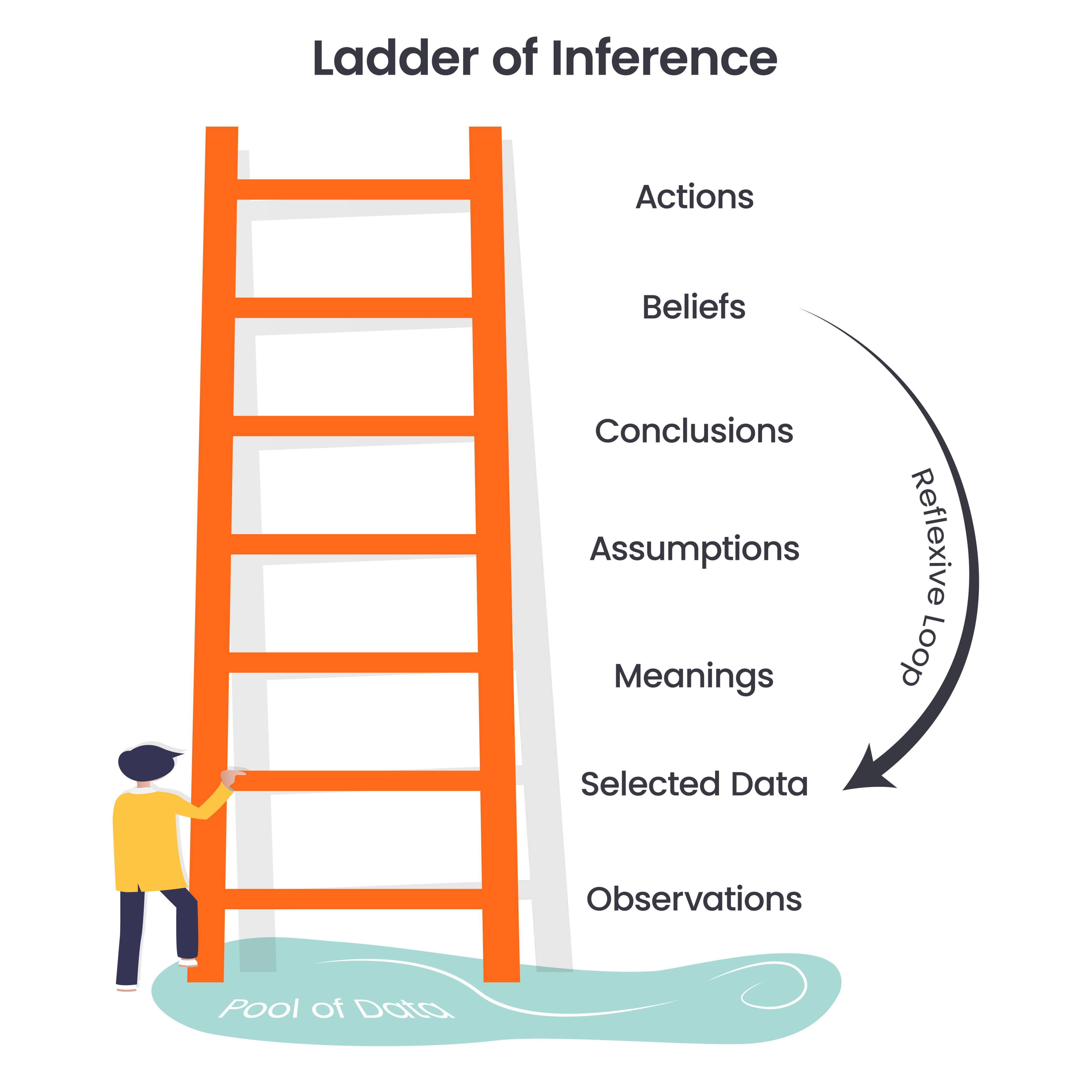
Think of the model as a ladder that we climb, often in a matter of seconds.
At the bottom is observable data — the things that can be seen or heard.
Then we begin climbing:
- We select data. Out of everything happening around us, we focus on certain details and ignore others.
- We add meaning. We interpret what those details mean based on our experiences, expectations, and beliefs.
- We make assumptions. We fill in missing information and create explanations for what we think is happening.
- We draw conclusions. Those assumptions become judgements about the situation or the people involved.
- We form beliefs. The conclusions reinforce what we believe to be true.
- We take action. We respond based on those beliefs.
The entire process can happen so quickly that it feels like we moved directly from observation to certainty.
Workplace Example
Let's revisit our meeting.
Observable data: a colleague looked at their laptop and didn't comment on your idea.
Meaning added: They seem disengaged.
Assumption: They aren't interested in what I'm saying.
Conclusion: They don't support my idea.
Belief: They're difficult to work with.
Action: You stop seeking their input on future projects.
Now imagine you learn later that they were taking notes because they wanted to discuss your idea afterward.
Same event. Very different interpretation.
Why it Matters
The Ladder of Inference isn't about eliminating assumptions — that's impossible. We all make them. The value of the model is recognizing when we've moved from what we know to what we think we know. Many workplace misunderstandings begin when assumptions go unexamined and quietly become "facts" in our minds. By slowing down and getting curious about what we might be missing, we create space for clearer communication and better conversations.
Climbing Back Down
The next time you find yourself making a quick judgement, pause and ask:
- What did I actually observe?
- What assumptions am I making?
- What evidence supports my conclusion?
- What other explanations could be true?
- What question could I ask to learn more?
These questions help us shift from certainty to curiosity — and curiosity is often where better communication begins.
The Bottom Line
The Ladder of Inference reminds us that there is a difference between what happened and the story we tell ourselves about what happened. The next time you're certain you know what someone meant, pause and ask yourself, "what do I know for sure, and what am I assuming?" That simple question can lead to better conversations, better decisions, and fewer misunderstandings.
Resources
Einstein, B. (2025, May 6). The ladder of inference: How to use it & examples. Harvard Business School Online.
Ladder of Inference AI Roleplay
PowerBites Session: The Ladder of Inference
Citations
Argyris, C. (n.d.). The ladder of inference. The Fifth Discipline Fieldbook. Retrieved May 8, 2026, from https://www.thercfgroup.com/files/resources/an-introduction-to-the-ladder-of-inference.pdf
Einstein, B. (2025, May 6). The ladder of inference: How to use it & examples. Harvard Business School Online. https://online.hbs.edu/blog/post/ladder-of-inference
Written by: Laura Beth Rogers, L&D Specialist | UAB Learning and Development