-
Learn to Win Challenge Inspires Adaptability at UAB


UAB employees recently leaned into growth and flexibility through the Learn to Win Challenge.
Centered on the theme “Adaptability: Thrive Through Change," the challenge encouraged participants to strengthen skills that support communication, resilience, and continued professional development in the LinkedIn Learning platform.
The design of the challenge made learning easy to fit into even the busiest schedules. Courses were broken into concise, bite-sized modules, allowing participants to engage without feeling overwhelmed. Progress tracking added an element of motivation, reinforcing learning as an active and rewarding experience rather than an obligation.
Two participants, Amy Raynor and Carin Mayo, were recognized as winners of the Learn to Win Challenge for their engagement and completion of the coursework within the required framework.
For Carin Mayo, the challenge stood out for its practicality and relevance, especially in a workplace navigating constant change. She often completed the 5 - 10 minute modules during her lunch breaks, appreciating how the short segments made it easier to stay focused and consistent.
“I found the training extremely timely,” Carin shared. “So much of what we encounter at work today requires us to be adaptable rather than resistant.”
One of Carin’s most meaningful takeaways was a deeper awareness of communication across generations. Working in a multigenerational environment at UAB, she reflected on how communication styles can differ widely and how easy it is to make assumptions about shared knowledge or experiences. The challenge helped her see the importance of adjusting her approach to better connect with colleagues of different ages, and she identified effective communication as the key skill she gained from the experience, and one she plans to continue developing.
Amy Raynor also found the challenge motivating and approachable. After completing the challenge, she described the experience as engaging and empowering, particularly noting how progress tracking and short courses helped maintain momentum.
“The Learn to Win Challenge was a fun and engaging experience,” Amy shared. “Being able to check the courses off created a sense of accomplishment. The standout aspect was how practical and relevant the material felt, and how manageable the bite-sized courses were. This challenge helped transform learning from what we ‘should do’ into something we were excited to do.”
As winners of the challenge, Carin Mayo won a one-month free membership to the UAB Campus Recreation Center, while Amy Raynor received two tickets to a performance at the UAB Alys Stephens Center.
The Learn to Win Challenge reflects UAB L&D’s ongoing commitment to making learning meaningful, accessible, and energizing. By focusing on adaptability and delivering content in a way that respects employees’ time and attention, the challenge encouraged participants not only to build new skills, but to rediscover the value of continuous learning in a changing workplace.
To learn more or get started with LinkedIn Learning, please visit UAB's LinkedIn Learning page.
Written by:Hammond Lake, Communications Specialist
-
Stop Dodging Conflict; Start Driving Results

Dodging tough conversations doesn’t just keep the peace; it drains productivity, erodes trust, and costs organizations billions. Learn practical strategies to steer conflict toward constructive dialogue that fosters trust, efficiency, collaboration and greater innovation.
How much effort do you put into sidestepping tough conversations at work? Do you hesitate before calling out uncivil behavior directed at you? Maybe you ignore the eye-rolling during the monthly staff meeting. Or perhaps a teammate let the group down, and now the water-cooler conversations happen without them. If any of this sounds familiar, you may be practicing Conflict Avoidance—and it’s more costly than you think.
A 2023 Society for Human Resource Management (SHRM) report found that nearly 57 percent of employees experience incivility at work. The ripple effect is enormous: hours wasted each week ruminating, venting, or working around problems instead of addressing them head-on. This wasted time is like a thief; stealing productivity, innovation, and collaboration. The financial toll? Billions of dollars lost annually across U.S. organizations.
The good news is you can change the story. By leaning into conflict instead of dodging it, you can reduce frustration, strengthen relationships, and protect your team’s effectiveness. Here are four practical strategies, adapted from a VitalSmarts research study that continues to be cited today:
- Clarify the Core Issue: Don’t just chase the most painful or immediate problem. Pause and ask: “What problem do I really want to resolve?” and “What do I want to make sure doesn’t happen again?”
- Manage Your Emotional Response: We often assume negative intent and spin stories that fuel frustration. Reframe the story: instead of “They’re undermining me,” try “They may be missing key information.” Speak only after you’ve calmed your emotions.
- Master Your Opening Remarks: Start with a clear, non-defensive intention. For example: “I’d like to ask about something you said earlier. It’s not my intention to upset you; I just want to understand your perspective.”
- Highlight the Impact Respectfully: Help others see the effect of their behavior in a constructive way. For instance: “I’m raising this because I think your words could erode confidence in our department’s ability to deliver services.”
Yes, addressing conflict can feel uncomfortable. But research shows that those who step up spend less time complaining, avoiding problems, or feeling defeated. The payoff is real: lower turnover, reduced absenteeism, stronger collaboration, and more innovation. In short, courage in conversation pays dividends; for you, your team, and the organization.
Resources to Learn More- UAB L&D Programs:
- External Article: The Financial Cost of Workplace Conflict and Incivility in the US
- External Article: The Cost of Avoiding Conflict: A Case Study on Workplace Dysfunction and Resolution
Written by Tammy White -
The Power of the 5 Whys

Instead of treating symptoms like miscommunication or missed deadlines, the 5 Whys guides teams to the deeper cause — encouraging curiosity, clarity, and more impactful problem-solving.
In many workplace challenges — missed deadlines, communication breakdowns, customer frustrations — we often treat symptoms instead of uncovering what really caused the issue. That’s where the 5 Whys model comes in. It’s a straightforward method for finding the root cause of a problem by asking “why?” repeatedly until the deeper issue becomes clear.Instead of blaming people or guessing at solutions, the 5 Whys model encourages curiosity, thoughtful dialogue, and shared understanding. It works especially well in communication, teamwork, and process improvement because it helps groups slow down, reflect, and uncover what’s beneath the surface.
How it Works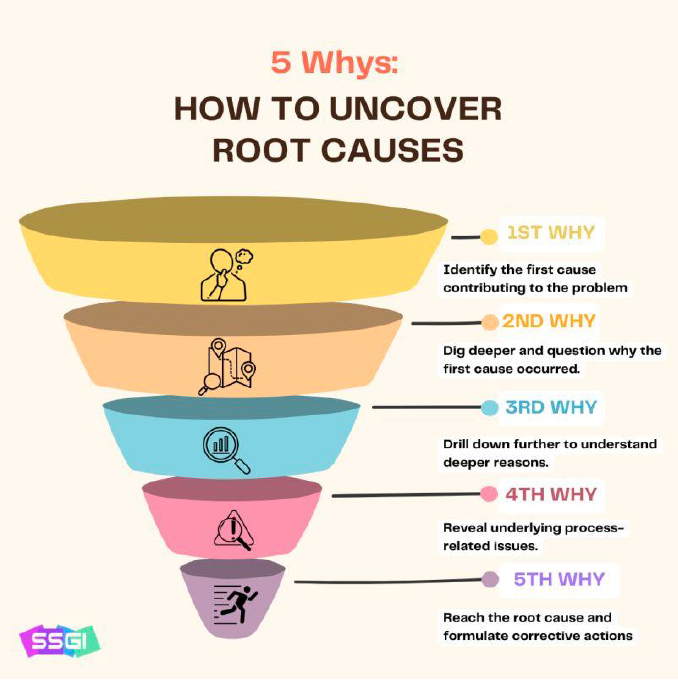 Clearly define the problem.
- Ask, “Why did this happen?” and write down the answer.
- For each answer, ask “Why?” again.
- Repeat until you’ve reached the root cause (often around five rounds).
- Create a solution that addresses the root — not just the symptom.
When to UseUse the 5 Whys model when...
- Miscommunication happens
- Conflict arises
- A process breaks
- A deadline is missed
- A handoff fails
Benefits- Encourages open dialogue
- Builds team alignment
- Avoids quick assumptions
- Reveals hidden issues
- Creates stronger solutions
Written by Laura Beth RogersReferences: Mind Tools. (n.d.). The 5 Whys: Getting to the root of a problem quickly. Six Sigma Global Institute. (2025).
-
The Story We Tell Ourselves
We make assumptions every day, often based on limited information. The Ladder of Inference provides a simple framework for recognizing those assumptions and making more informed decisions.
Imagine you're in a meeting and suggest a new idea.
A few people nod. One colleague stares at their laptop and says nothing.
By the end of the meeting, you've decided they're not supportive of your idea.
The interesting part? None of that was actually said.
What you observed was a colleague looking at their laptop and staying quiet. Everything else was an interpretation,. Most of us do this every day without realizing it. This is where the Ladder of Inference comes in.
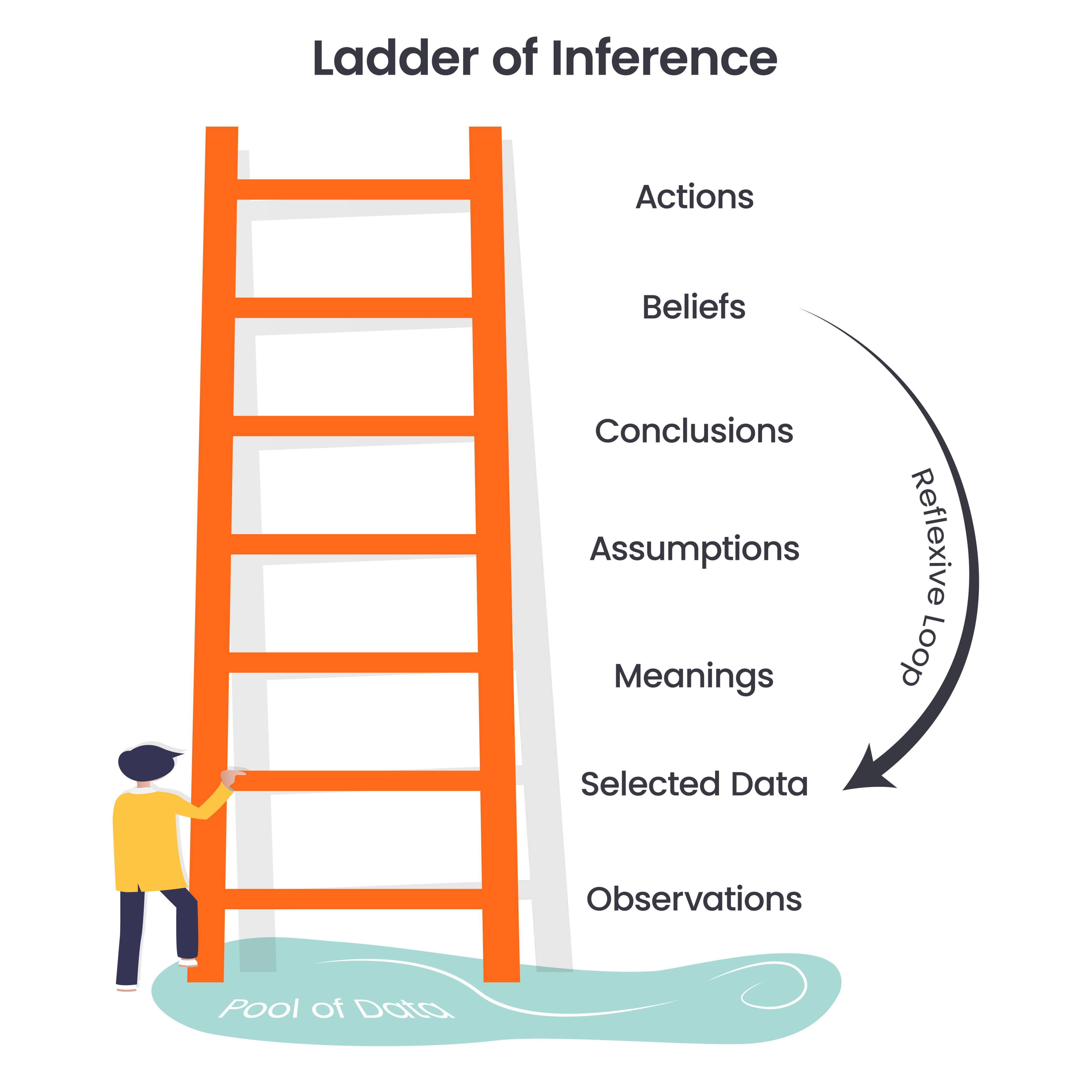
Developed by Chris Argyris and Donald Schön, the Ladder of Inference is a model that explains how people move from observing information to drawing conclusions and taking action. It reminds us that we're not always reacting to facts — we're often reacting to the meaning we've attached to those facts.
How the Ladder Works
Think of the model as a ladder that we climb, often in a matter of seconds.
At the bottom is observable data — the things that can be seen or heard.
Then we begin climbing:
- We select data. Out of everything happening around us, we focus on certain details and ignore others.
- We add meaning. We interpret what those details mean based on our experiences, expectations, and beliefs.
- We make assumptions. We fill in missing information and create explanations for what we think is happening.
- We draw conclusions. Those assumptions become judgements about the situation or the people involved.
- We form beliefs. The conclusions reinforce what we believe to be true.
- We take action. We respond based on those beliefs.
The entire process can happen so quickly that it feels like we moved directly from observation to certainty.
Workplace Example
Let's revisit our meeting.
Observable data: a colleague looked at their laptop and didn't comment on your idea.
Meaning added: They seem disengaged.
Assumption: They aren't interested in what I'm saying.
Conclusion: They don't support my idea.
Belief: They're difficult to work with.
Action: You stop seeking their input on future projects.
Now imagine you learn later that they were taking notes because they wanted to discuss your idea afterward.
Same event. Very different interpretation.
Why it Matters
The Ladder of Inference isn't about eliminating assumptions — that's impossible. We all make them. The value of the model is recognizing when we've moved from what we know to what we think we know. Many workplace misunderstandings begin when assumptions go unexamined and quietly become "facts" in our minds. By slowing down and getting curious about what we might be missing, we create space for clearer communication and better conversations.
Climbing Back Down
The next time you find yourself making a quick judgement, pause and ask:
- What did I actually observe?
- What assumptions am I making?
- What evidence supports my conclusion?
- What other explanations could be true?
- What question could I ask to learn more?
These questions help us shift from certainty to curiosity — and curiosity is often where better communication begins.
The Bottom Line
The Ladder of Inference reminds us that there is a difference between what happened and the story we tell ourselves about what happened. The next time you're certain you know what someone meant, pause and ask yourself, "what do I know for sure, and what am I assuming?" That simple question can lead to better conversations, better decisions, and fewer misunderstandings.
Resources
Einstein, B. (2025, May 6).The ladder of inference: How to use it & examples. Harvard Business School Online.
Ladder of Inference AI Roleplay
PowerBites Session: The Ladder of Inference
Citations
Argyris, C. (n.d.).The ladder of inference. The Fifth Discipline Fieldbook. RetrievedMay 8, 2026, fromhttps://www.thercfgroup.com/files/resources/an-introduction-to-the-ladder-of-inference.pdf
Einstein, B. (2025, May 6).The ladder of inference: How to use it & examples. Harvard Business School Online.https://online.hbs.edu/blog/post/ladder-of-inference
Written by:Laura Beth Rogers, L&D Specialist | UAB Learning and Development