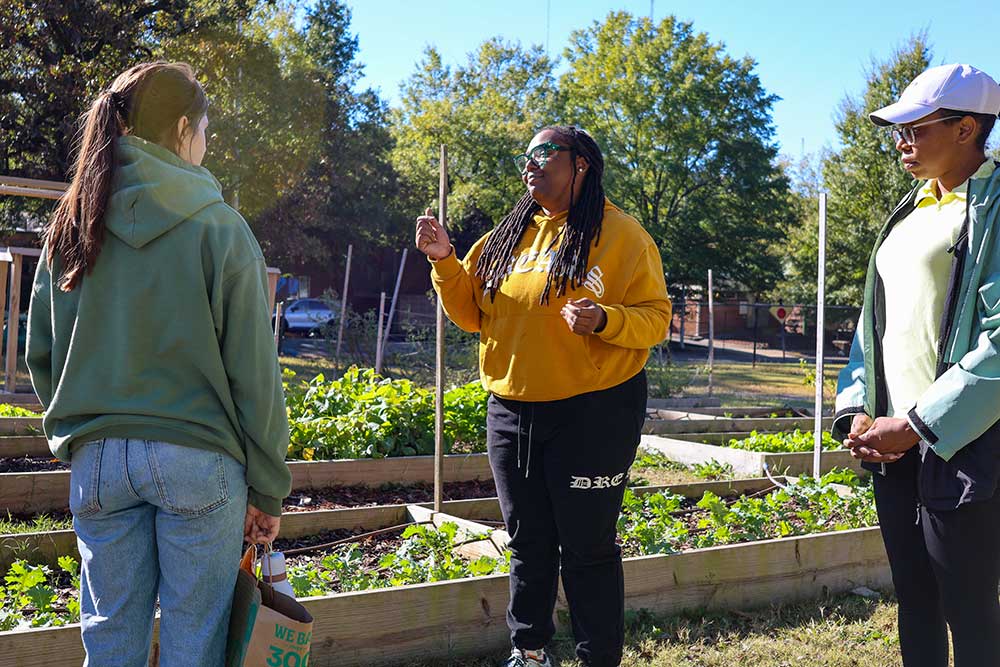
 Dr. Amanda Clark, center, with volunteers in the Blazer Kitchen Garden (Source: Audrey Womack)In the heart of Birmingham, nestled behind the hum of campus life, the University of Alabama at Birmingham’s (UAB) Blazer Kitchen Garden is quietly transforming the way a community thinks about food, education, and sustainability.
Founded in 2020 by Winston Lancaster, Ph.D., Blazer Kitchen Garden began as a modest initiative to supply organic vegetables to Blazer Kitchen, UAB’s on-campus food pantry. Today, under the stewardship of Amanda Clark, Ph.D., it’s blossoming into a hub of innovation and outreach.
Clark’s vision is clear: maximize every inch of space, double production, and turn the garden into a living classroom. At peak production, the garden can yield 20 to 30 pounds of fresh produce weekly from 10 beds, each planted with a single crop per square foot. But Clark sees potential far beyond those numbers.
“There is tremendous capacity in this small plot of land,” said Clark, a former TL1 Scholar under UAB’s KUH PRIME, an interdisciplinary initiative bringing together kidney, urology, and non-malignant hematology researchers and scholars from across UAB, Tulane University, and Augusta University. “With careful planning, tireless volunteer hours, and thoughtful support, Blazer Kitchen Garden could double its production and increase the fresh food supply to our community members that need it the most.”
By transitioning to intensive square-foot gardening methods, constructing vertical frames for crops like squash and tomatoes, and building hoop houses to extend the growing season, Clark anticipates a significant boost in output. A greenhouse is also on the horizon, which could push production even further.
A Birmingham native, Clark attended UAB as an undergraduate and completed her Ph.D. at Auburn University. She started in medical research and completed her graduate training in evolutionary biology. Now back into medical research, she focuses on the cellular dynamics of kidney diseases, with a passion for pediatrics.
Cultivating Community and Education
Blazer Garden isn’t just about food—it’s about people. Every Saturday, it opens its gates to the community, offering access to fresh produce and a glimpse into sustainable urban agriculture. Clark hopes to deepen this connection by launching educational workshops, inviting volunteers, and creating opportunities for hands-on learning.
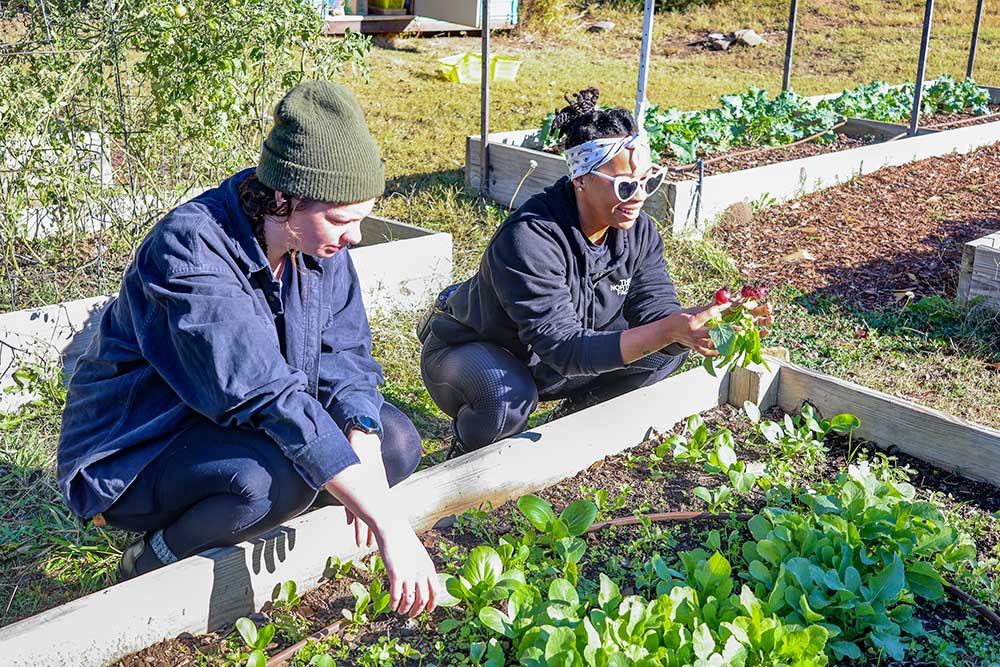 Volunteers harvesting radishes in Blazer Kitchen Garden (Source: Audrey Womack)Student engagement is a cornerstone of the expansion. The garden is poised to become a space for agricultural demonstrations and controlled experiments—ideal for capstone projects and interdisciplinary research. Clark is already collaborating with master’s students, social work interns, and sorority members, and she has reached out to the UAB Postdoctoral Associations and her own department to broaden participation.
To support these plans, Clark is supporting a joint grant application from Jones Valley Teaching Farm and the City of Birmingham aimed at expanding the garden’s capacity and growing season. Backup grant options are in place, and Clark continues to seek donations and volunteers to help build the infrastructure needed to realize her vision.
“We are so lucky to have Dr. Clark shepherding the next phases of expansion at Blazer Kitchen Garden,” said Lisa Higginbotham, Manager of the UAB Benevolent Fund, which oversees Blazer Kitchen. “With expertise ecological and biological systems and deep involvement in the UAB student community, she is well suited to take Blazer Kitchen to the next level to serve even more UAB students, patients, and the surrounding community.”
Blazer Kitchen Garden is more than a patch of green, said Higginbotham. With Clark’s leadership and the support of the UAB community, it’s poised to become a model for urban agriculture, education, and community resilience.
If you are interested in volunteering in Blazer Garden, sign up here.
Volunteer with Blazer Kitchen Garden Opens an external link.