by Satina Richardson
A new Neuro-Vision Rehabilitation Clinic at UAB Spain Rehabilitation Center is bringing specialized vision care to inpatients recovering from stroke and other acquired neurological injuries.
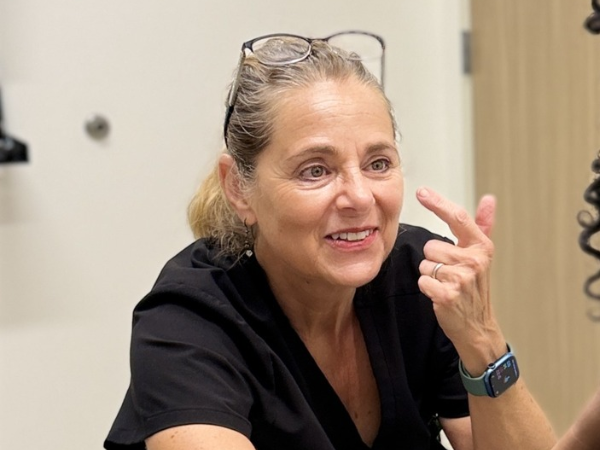
Drawing on more than 30 years of experience in neuro-visual rehabilitation, Lynn Greenspan, OD, PhD, FAAO, Diplomate PH/EV, FNAP, helped establish the collaborative partnership to integrate specialized vision services into the inpatient rehabilitation setting.
“Visual deficits are frequently overlooked during the early stages of recovery from a neurological injury, often because of limited access to specialists,” said Reid Warren, DPT, MSHA, director of Inpatient Rehabilitation Therapy at Spain Rehabilitation Center. “The new clinic helps identify these impairments within the first week of admission to the rehabilitation hospital so that the care team can integrate strategies to address impairments into the patient’s rehabilitation care plan and coordinate follow-up services after discharge.”
Greenspan explained that a substantial portion of the brain is involved in processing visual information or supporting visually guided activities. Consequently, neurological injuries, including stroke, traumatic brain injury and compressive lesions, can disrupt multiple aspects of visual function.
Common visual complications following stroke include visual field loss, spatial neglect and double vision, or diplopia. Patients may also experience restricted eye movements, difficulty coordinating their eyes or impaired eyelid function, including an inability to fully open or close the eyelids.
These conditions can significantly interfere with rehabilitation. For example, a patient experiencing double vision, difficulty locating objects on one side or restricted eye movements may struggle with activities essential to physical, occupational and speech therapy.
“Our goal is to identify and address visual problems that could interfere with a patient’s ability to participate fully in rehabilitation,” Greenspan said. “When visual impairments are recognized and appropriately managed, patients have a better opportunity to engage in therapy and achieve their rehabilitation goals.”
An integrated approach to patient care
Patients at Spain Rehabilitation Center benefit from a comprehensive, interdisciplinary approach in which providers from multiple specialties collaborate to support recovery and improve functional outcomes.
Through this coordinated system, patients are referred to Greenspan by members of their rehabilitation care teams when visual concerns are identified.
“In many health care settings, specialists tend to work independently, often in separate silos,” Greenspan said. “At Spain Rehabilitation Center, there is a strong culture of communication and collaboration. We have regular meetings, ongoing consultations, and an established network that allows us to coordinate care and address patients’ needs together.”
Specialized vision care for patients with complex needs
Greenspan’s evaluation begins with a comprehensive eye examination, supplemented by specialized testing when indicated. She also assesses patients’ current eyeglass prescriptions to determine whether uncorrected refractive errors may be contributing to visual difficulties.
Because many patients recovering from neurological injuries have significant physical limitations, examinations frequently require specialized handheld instruments and modifications to conventional testing procedures.
Some patients use wheelchairs, while others have impaired trunk control, reduced endurance or difficulty maintaining an upright seated position.
“We use specialized handheld instruments that allow us to examine patients in positions that accommodate their physical limitations,” Greenspan explained. “For example, our handheld tonometer can accurately measure intraocular pressure even when a patient needs to remain in a reclined position.”
For patients who cannot be transported by wheelchair to the clinic, specialized portable equipment will also support bedside examinations.
“Some patients have limited sitting tolerance, reduced attention spans, or significant discomfort,” Greenspan said. “They may be unable to sit upright for extended periods or maintain the position required for conventional examination equipment. We adapt our examination techniques and instrumentation to meet each patient’s individual needs.”
Expanding care and clinical education
Greenspan brings more than three decades of experience in clinical care and optometric education. Before joining UAB, she served as a clinical specialist in low vision and vision rehabilitation and directed the vision clinic at Bryn Mawr Rehabilitation Hospital in Malvern, Pennsylvania, where she specialized in neuro-vision rehabilitation for patients with stroke, traumatic brain injuries and other acquired neurological conditions.
Her goals include expanding neuro-vision rehabilitation services to reach a broader population of patients with traumatic and acquired brain injuries throughout Spain Rehabilitation Center. Warren noted that the new service has been enthusiastically received and sees significant potential for continued growth.
“We have seen considerable enthusiasm and demand for these services, which speaks to their importance in the rehabilitation process,” Warren said. “We hope to continue expanding our capacity to provide comprehensive visual evaluations and targeted interventions as part of each patient’s rehabilitation.”
Greenspan also plans to establish a clinical rotation that will provide optometry students with hands-on experience in neuro-vision rehabilitation, preparing them to recognize and address visual dysfunction associated with neurological injuries.
“Even if students don’t ultimately specialize in neuro-vision rehabilitation, they should understand the important role vision care can play in recovery following a stroke or other neurological injury,” Greenspan said. “There is tremendous potential for UAB to become a center of excellence in neuro-vision rehabilitation, advancing patient care, clinical education, and interdisciplinary collaboration. That’s an exciting possibility, especially when you consider what it could mean for our patients.”