Key Insights
The University of Alabama at Birmingham has accepted an invitation to join the Association of American Universities, becoming Alabama’s first and only AAU member institution. AAU membership recognizes leading research universities in the United States and Canada based on excellence in research, scholarship and education. UAB reports more than $915 million in annual research expenditures and is Alabama’s largest employer, with more than 37,000 employees
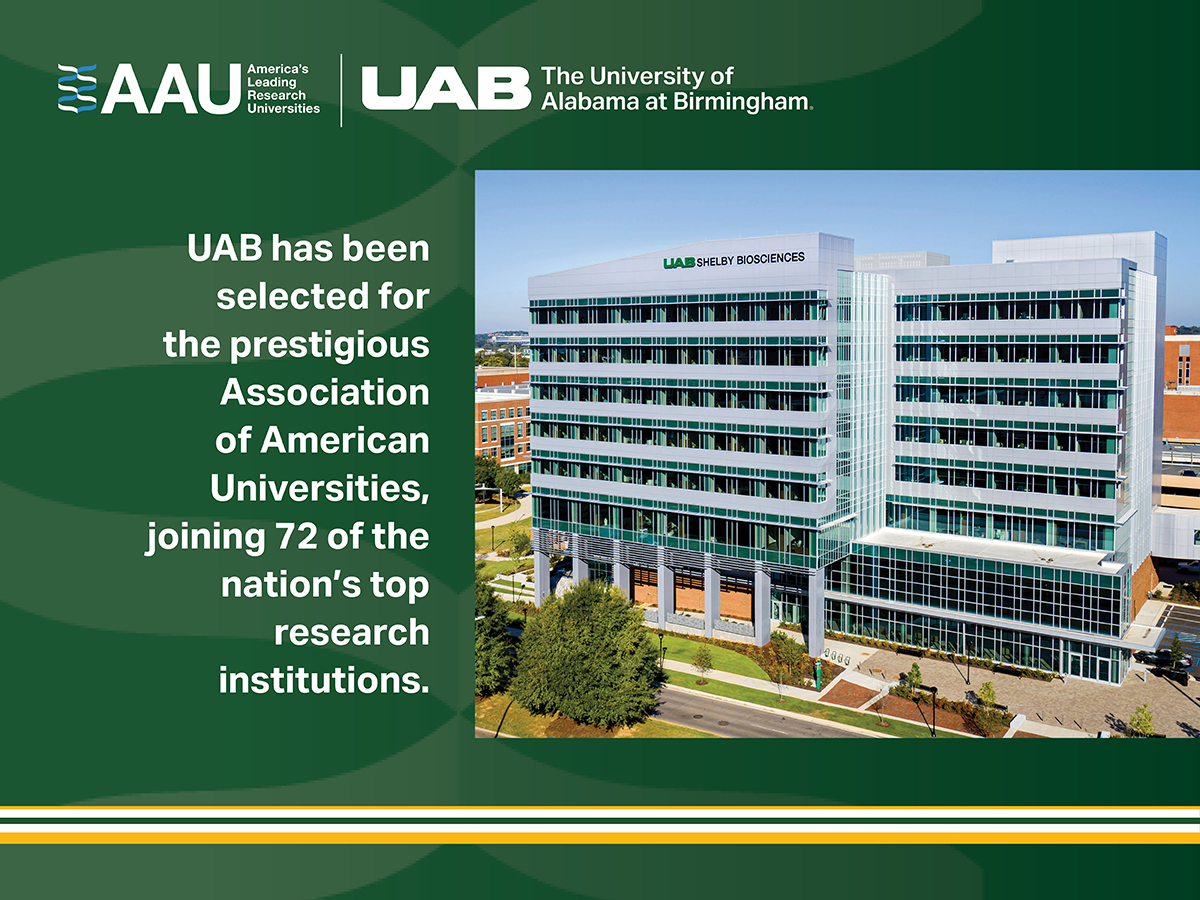 The University of Alabama at Birmingham has accepted an invitation to join the Association of American Universities, securing UAB’s place among the most prominent and impactful institutions of higher education and research in the United States and Canada.
Since the AAU’s founding in 1900, its members have represented the nation’s leading research universities for more than 125 years. Membership is based on an extensive set of quantitative indicators that assess the breadth and quality of a university’s research and education.
“Being asked to join the AAU is an honor that recognizes the great work and results driven by UAB’s talented faculty and staff, the support of our public and private partners, and the unwavering dedication of the University of Alabama System Board of Trustees,” said UAB President Ray L. Watts, M.D. “I want to thank the AAU Board and Membership Committee for recognizing UAB among the distinguished institutions that compose this prestigious association. We look forward to contributing to the AAU’s important mission.”
The AAU last added members in 2023 and, with the addition of UAB and Georgetown University this week, has 73 members on the edge of innovation, scholarship and solutions that contribute to scientific progress, economic development, security and well-being.
“We are proud to welcome these two outstanding universities to AAU,” AAU President Barbara R. Snyder said. “We look forward to working together with both of them to continue advancing and improving higher education and driving the critical American university research and innovation behind the breakthroughs that strengthen the U.S. economy, lead to new cures and treatments for Americans, help hardworking farmers do better, and help protect our military service members in the field.”
Since Watts became UAB’s president in 2013, the university’s annual research expenditures have increased from $379 million to more than $915 million.
“UAB has significantly increased its research portfolio in recent years, and President Watts often reminds us that research expenditures don’t just represent dollars — they represent saving and improving more people’s lives,” said University of Alabama System Chancellor Sid J. Trant. “I commend President Watts, his leadership team, and every student, faculty, staff member and supporter who have contributed to UAB’s growing prominence and reputation for research, education excellence and real-world impact.”
UAB is Alabama’s largest employer, with more than 37,000 employees across the university and Health System, which includes 15 hospitals and the fifth-largest hospital in the United States. The university offers more than 180 undergraduate, graduate, doctoral, professional and online degree programs and has enrolled its largest-ever freshman class in two consecutive years.
“AAU membership is an indicator of UAB’s broad excellence across educational and research programs,” said UAB Provost Janet Woodruff-Borden, Ph.D. “It is gratifying to know that other distinguished institutions recognize UAB as an AAU peer, and we will not rest. We have invested in future growth through our Research Strategic Initiative and Student SUCCESS initiative and will continue to build the kind of positive momentum that earned AAU’s recognition.”
Several UAB schools secured prominent rankings for National Institutes of Health funding, according to Blue Ridge Institute for Medical Research: School of Health Professions (No. 9), School of Nursing (No. 11), School of Dentistry (No. 15) and Heersink School of Medicine (No. 28). In addition, 12 Heersink departments and divisions ranked among the Top 25 nationally.
“UAB’s commitment to advancing scholarship, research and innovation has fueled remarkable growth in our capabilities and generated meaningful impact across the institution, throughout Alabama and far beyond,” said David Standaert, M.D., Ph.D., a renowned researcher and clinical neurologist who served 15 years as chair of the UAB Department of Neurology (BRIMR No. 22) and became UAB’s vice president for Research in October. “The progress we have achieved would have been difficult to imagine when I joined UAB 20 years ago. The AAU represents America’s premier research universities, and UAB has the foundation, talent and momentum to compete at the highest level. We look forward to helping build a brighter future through discovery, innovation and collaboration.”
UAB is the first and only AAU member in Alabama. Other AAU members in the Southeast include Duke University, Emory University, the University of Florida, Georgia Institute of Technology, the University of Miami, the University of North Carolina at Chapel Hill, the University of South Florida, Tulane University, Vanderbilt University and the University of Virginia. Nationally, members include Ivy League universities and institutions like Carnegie Mellon University, the University of Chicago, Johns Hopkins University, Massachusetts Institute of Technology, Northwestern University and Stanford University, among many other distinguished institutions.
“We are grateful to add to the breadth and depth of our membership with the University of Alabama at Birmingham and Georgetown University, each of whom reflect the extraordinary promise of research universities to expand pathways to opportunity, support the flourishing of our cities and towns, and enable faculty, staff and students to fuel a culture of discovery and invention,” said AAU Board Chair and Johns Hopkins University President Ron Daniels. “With this expansion, we have a distinct opportunity to broaden the reach of and affirm our promise to new communities.”